Monday, November 25, 2013

India stands to gain from GE's digital business ramp-up, says John G Rice

MUMBAI: Jack Welch, the former CEO of General Electric, didn't come to India in the late 1980s to
sell outsourcing. He had jet engines and plastics on his mind. But meetings with  top Indian  government advisors and CEOs quickly convinced him about India's invaluable  status as a low-cost, offshore destination for outsourced services. A series of  decisions led to the creation of Gecis (today's Genpact) and the rest, as they say, is  history.

Today, GE is also unrecognisable from the company Jack Welch ran in the late 1980s. From an  industrial infrastructure powerhouse, it became a financial services giant in  the boom years of 2002-2008 and is now on the threshold of another big change, a  revolution in complex algorithms, sensors and communication that will make  machines smarter and trigger big productivity gains. GE still makes those big machines that require millions of dollars of investment such as the wind and gas
turbines  the jet engines that power the A380s and medical equipment which fight and  detect cancer. But in the coming years, these machines will become smarter, be  able to talk to each other and provide massive amounts of data for GE analysts  to pore through and detect possible problems and dangers.

The industrial internet, or big data, is GE's  next big bet and India, which benefitted immensely from a GE-led foray into  outsourcing in the late 1980s, may get a big part to play in this transformation.
 
John G Rice, vice chairman and president and CEO of GE global growth and  operations, says
complex software and sensors that improve a machine's  performance will be big  business for the company in the coming years.

 "GE is a software giant, we already are. It is embedded in our business, people don't notice it," Rice
says. "The opportunity this unlocks is enormous. Because in the past we were just squeezing productivity out of an engine, such as lower noise, higher fuel efficiency etc. Now, that is certainly very valuable but a relatively small piece of the whole system. Now, we are starting  to get into the rest of the system. Think about the downtime on a big pipeline if one compressor goes down."

So, what is industrial internet, or the internet of all things? And why is it so important for GE? Every year GE produces jet engines, gas turbines and other industrial equipment that find a  place in many infrastructure . GE wind turbines power windmills and GE built locomotives ferry goods on
railtracks around the world.GE has also developed software and sensors  that monitor their performance on a real time basis. Mountains of data stream are streamed from these machines every day and it helps GE analysts and managers  track performance, predict problems and suggest solutions.

"For 15 years, we have been developing sensors and tech to monitor equipment performance
in situ," says Rice. We have 250 sensors in gas turbine streaming data back, we monitor 1,800 around
the world every day. We are understanding every vibration, heat, and we can see an incipient failure or problem before people on the ground can see it. That's all software."

For example, GE is a big producer of jet engines. Tracking its performance can help engineers understand potential problems and vulnerabilities and suggest solutions before something catastrophic happens. "I see a,b, c, d and e that means f is going to happen. You have to stop this machine, and go do something before f happens."

But predicting itself will only get you thus far. GE wants to go beyond that and suggest recovery solutions. For instance, how do you get a replace ,how do you get a replacement aircraft quickly enough if one has to be grounded due to an engine inspection. It is soon going to introduce an application for the aviation industry that will check air traffic patterns, weather and wind patterns and suggest the amount of fuel that should be used in an aircraft.

"Over the years, we have created a company of almost 10,000 software engineers. If you look at the world software companies, we would be in the top 20 in terms of size," ..

So what is in it for India? Rice says India's software engineers are already  working on many of the complex algorithms used to transmit and analyse data. GE could increase its investment in R&D facilities and hire more software engineers as demand grows for its digital business.

"In terms of software engineers, India has to be one of the top five places, globally. We already do some of the work in Bangalore where we have a huge research facility," Rice says.

GE has just invested about $200 million in a facility in Pune, which will combine manufacturing of all its business divisions under one roof. Since some businesses are not so big to have a standalone plant, this facility will provide space and skilled workforce. This model facility will soon be taken worldwide and adapted to other conditions.

The investment comes at a time when India's governance is being severely criticised for its slow pace of execution and failure in taking decisions. Rice says he won't single India out as most developing countries have similar problems. "You play the hand that you are dealt in a country like this. We want to move faster, but we are not going anywhere."

For India's software engineering community and start-ups that mine data, GE's digital business ramp-up could be a huge opportunity both in terms of employment and business deals.

 

Thursday, November 21, 2013

A guerrilla attempt in film financing

Back in the 1980s, Malayali filmmaker John Abraham and his Odessa Collective team went around villages in Kerala asking for money to make a ‘people’s film’. They entertained villagers with music, street plays and skits. In return, thousands of people chipped in small sums of money, bought food for John and his team and took care of their stay.
 
The result was the 1986 cult film Amma Ariyaan. The film broke all conventions of film-making, distribution and exhibition. Made in the pre-internet era, it was the first crowd-funded South Indian movie.
 
Today, a group of creative people are in the process of making the first crowd-funded Malayalam movie with online contributions. “Oraalpokkam has no producer in the conventional sense,” Sanalkumar Sasidharan, who directs the film, told Business Line. “The money will come from people who are fascinated with our project and who trust us.” Oraalpokkam (meaning ‘as tall as a man’ in Malayalam; but Sanalkumar translates it as ‘six-feet high’) will be a 90-minute movie that will trace the travels and travails — internal and external — of one partner after a couple splits up.
 
Kazhcha Film Forum has tied up with Springr (www.springr.me), which is a ‘crowd-funding platform and community-building tool for creative projects and ideas’ for sourcing funds for the film. Springr promises to help creative people ‘access funding beyond official channels by talking directly to consumers, fans, peers and like-minded strangers.’ Those fascinated with the film idea can go to the Springr website and make a funding commitment. Those paying more than Rs 25,000 will have a unique way of redeeming their investment — they will get the internet rights of the film. They can screen the film and keep a half of the proceeds for themselves.
 
“In terms of funding, ours is a guerilla attempt,” Sanalkumar says. “Oraalpokkam will be a low-budget movie, with just Rs 35 lakh as the cost,” he said. “The creative people associated with the film will not take fees,” he said.
 
Crowd-funding (Wikipedia defines it as the collective effort of individuals who network and pool their money, usually via internet, to support efforts initiated by other people or organisations) of movie-making is gradually picking up in India. Until recently, it confined itself to documentaries, mainly for public interest. Many environmental documentaries have been made with the help of this platform. However, because of their high cost and complex nature, feature films could not attract crowd-funds.
 
Chennai-based poet-activist Meena Kandasamy will don the female lead role in Oraalpokkam while actor and filmmaker Prakash Bare will be the male lead.

Wednesday, November 20, 2013

Indian entrepreneurs have potential to build next Google: Eric Schmidt

India’s entrepreneurial innovators have the potential to build the “next Google” if the country “plays its cards right” and ensures Internet access for millions of its citizens, Google’s executive chairman Eric Schmidt has said.
 
In an essay written for the book ‘Reimagining India: Unlocking The Potential of Asia’s Next Superpower’ edited by global consulting firm McKinsey, Schmidt dubbed India “an Internet laggard” saying he feels Internet in the country today is like where it was in America in about 1994 — four years before Google was even born.
 
He said India must increase its Internet penetration across towns and cities, a move that will have a positive impact on its economy and society.
The former Google CEO said he witnessed the creative potential of India’s people all around him in Silicon Valley where India-born entrepreneurs account for 40% of start-ups.
“Just think what will happen when India’s entrepreneurial innovators are able to create great global companies without leaving their country. They will change the world. Hundreds of large firms focused on the Internet will be founded and will succeed by focusing purely on Indian consumers, Indian taste, Indian style, Indian sports.”
 
“Can anyone of those companies ultimately become the next Google? Of course.” “That may not happen for quite a few years. But if India plays its cards right, we will soon see Indian engineers and small businesses tackling Indian problems first, then exporting the solutions that work best,” Schmidt said.
 
With a total population of 1.2 billion, India has over 600 million mobile-phone users but only about 150 million people regularly connect to the Internet.
 
In 2011, India’s Internet penetration rate was 11%, “far below” that of developed nations where penetration rates average 70%. India’s Internet penetration rate is less than a third of China’s penetration ratio of 38% and less than half of those in developing countries, which average 24%.
“By any reasonable definition, India is an Internet laggard... In spite of its well deserved reputation as one of the world’s leading IT and software development hubs, India is far from being the connected society many foreigners imagine,” Schmidt said.
 
The number of India’s broadband users, 20 million, is even smaller, Schmidt said however adding that India is on the cusp of a connectivity revolution.
“I believe India has the chance to leapfrog its current connectivity challenges, bring Internet access to a majority of its citizens — and even raise its penetration ratio to 60 or 70% within the next 5-10 years,” he said.

Tuesday, November 19, 2013

Perspective Plan aimed at putting sheen back on Kerala Development Model

Interview with K.M. Chandrasekhar, Vice-Chairman, Kerala Planning Board
Kerala Perspective Plan 2030, drafted by the State’s Planning Board, is aimed at attaining development parameters of high-income counties over a two-decade period. The board claims KPP 2030 represents a “move away from traditional planning processes to outcome-based strategic planning.”
The draft plan has been formulated in consultation with policy-makers, administrators, academicians, NGOs, civil society members, and public and private enterprises. Creation of a knowledge-based economy is claimed to be central to the plan. And, productively using the huge remittances sent in by Keralites overseas (over Rs 60,000 crores last year alone) is a huge challenge.
In an interview to Business Line, State Planning Board Vice-Chairman K.M. Chandrasekhar discusses the vision behind the plan. Excerpts:
What is the rationale behind the Kerala Perspective Plan?
Kerala’s achievements in terms of Human Development indicators such as education, health, and demographic features have been globally acknowledged. Kerala has undergone the first stage of economic transition from primary to non-primary sector. The second stage of structural transformation is characterised by intra-sectoral restructuring from low to high value added activities.
In 2010, Kerala’s per capita GSDP (gross State domestic product), in 2005 PPP dollars, was about $4763, which is equivalent to the lower middle-income category as per the World Bank classification. However, growth has not been accompanied by the structural transformations in terms of GSDP. The Kerala economy seems to be trapped in low value adding activities.
If Kerala continues on the business-as-usual path, the scenario for 2030 looks grim. A major growth challenge is to pull the economy out of the vicious cycle of low productivity, poor quality, high unemployment and social and environmental degradation to a virtuous circle of high-quality growth.
The challenge is to increase competitiveness and productivity by reforming the investment climate through infrastructure reforms. Kerala needs to reconsider its development strategy in order to gain considerable autonomy in growth and become a major player in the national and global economy.
The Kerala development model has already lost its sheen. How will the perspective plan bring back its glory?
The core idea is to carry forward the Kerala development model to position Kerala in the international market in the case of health and education (human capital). Necessarily, this will upgrade human capital to grow at that level, accelerating Kerala growth and benefiting its people.
Kerala’s healthcare system had until recently been known for its public-funded, low-cost hospitals and primary health centres. This has now largely been replaced by a high-cost private healthcare system. What is the plan going to do to strengthen the public system?
KPP 2030 specifically emphasises the role of public investment in the health sector. According to the Plan, public investment in health sector is the basic requirement for sustainable development. It is proposed in this document that public sector investment in the health sector must increase up to 5 per cent as a proportion of GSDP by 2030.
This target can be reached in a phased manner. In the current Five-Year Plan of 2012-17, the government can target to spend around 1-2 per cent of its GDP on healthcare. This can be increased to 2-3 per cent in 2017-21, to 3-4 per cent in 2022-26 and finally 4-5per cent in 2027-31.
‘Emigrants as development partners’ is a lofty ideal, but how can this be put into practice?
The Perspective Plan suggests special funds such as Infrastructure Development Fund, Kerala Fund etc to be formed by mobilising resources from Non-Resident Keralites. These funds will exclusively focus on developing infrastructure and institutions which will enable implementation of the KPP 2030. The strategies suggested in KPP 2030 will be converted into suitable projects at the stage of implementation in due course.
In a State where the LDF and UDF administrations alternate every five years, wouldn’t the continuity be lost as each has its own approach to development?
This is a Perspective Plan for the State. It will be linked with Five Year Plans and will be implemented for the progress of the State. The fact that it is being put up for public comment is in itself indicative of the government’s desire to build a consensus on the board future development strategy.

Monday, November 11, 2013

What makes Israel with just eight million people, an innovation hub

The presence of thousands of startups, and more engineers per capita than anywhere else in the world, makes Israel a natural hub for innovation.

Best known for defence- and - military-inspired technologies, entrepreneurs across the nation are now focussed on building the next generation of healthcare applications. Helped by government support, societal acceptance and the presence of large numbers of multinationals eager to buy innovative technology from startups, Israeli companies are building a wide range of products and services.

Using artificial intelligence and digital technology, they are creating applications for diagnostics, tools for the visually, physically and mentally challenged as well as products that can improve farm output. "Many visually disabled people are old people who don't care about smartphones," said Yonatan Wexler, vice president for research and development at OrCam, a startup launched in 2010 by Amnon Shashua, a computer science professor at Hebrew University.

Using technology developed by Shashua, Wexler and another faculty member, Shai Shalev-Shwartz, they have created a device that can be clipped onto spectacles, making it possible for a blind person to read, find an item, catch a bus or cross the road. "For us the issue of innovation is not a hobby. It is basically about who we are and what our economy is built on," said Avi Hasson, chief scientist at the ministry of economy. "This was a country selling oranges to the world and not high tech. We have now decided to build our economy around the knowledge industries." Currently half of all Israeli exports come from the technology industry.
What makes Israel with just eight million people, an innovation hub
So, what is Israel's "secret sauce" that has made it a global startup hub? Experts said the "bottom up" approach of the government to fund innovative projects is unique in the world of early-stage research and development funding. For India's nascent startup ecosystem, the Israeli experience offers several valuable lessons.

Israel's research and development expenditure account for approximately 5% of the country's $260 billion (Rs16 lakh crore) GDP, higher than any other western country. This excludes the spending on defence R&D. The office of the chief scientist has a budget of $450 million (Rs2,800 crore)annually and always co-invests along with the private sector. "We do not try to replace the private sector, but rather complement it; we like risky projects," said Hasson, who worked as general partner at Gemini Israel Funds.  Typical grants are in the range of $30,000 to $6 million (Rs18 lakh to Rs37 crore).

There are also around 300 multinational companies in the country which are a big part of the ecosystem. Many of them, including Apple, Google, Intel, Microsoft, General Motors and GE, have set up research and development facilities to use the local talent and come up with breakthroughs.

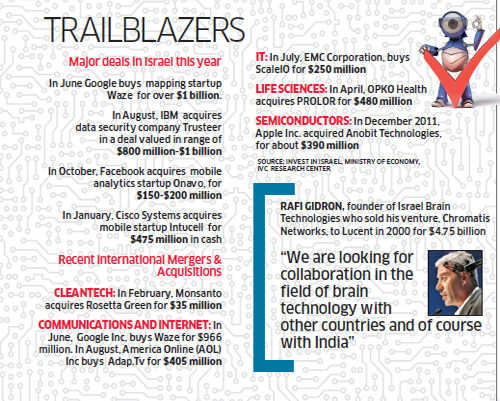
"You have 20-year-old kids here; their education is not to follow instructions, but to lead and solve problems," said Yossi Matias, managing director of Google's Israel R&D centre and a top computer scientist. In June, Google bought Israeli mapping startup Waze for over $1 billion (about Rs6,200 crore).

In 2012, M&A deals involving Israeli and Israel-related companies were valued at $9.74 billion (Rs60,700 crore), an 88% increase from $5.2 billion (Rs 32,000 crore) in 2011, according to Israel's IVC Research Center  database. Besides acquisitions, many of these multinationals provide space for entrepreneurs to meet and help them to bootstrap their ideas. In 2012, six of the 10 largest acquisitions involved venturebacked targets.
 
Per capita, Israel has attracted over twice as much venture capital investment as the United States and 30 times more than all the members of the European Union  combined. An example of Israel's farsightedness is the fact that it set up a seed fund called Yozma more than two decades ago. Today, there are about 70 active venture capital funds in Israel, of which 14 are international.

Around 575 Israeli high-tech companies raised $1.92 billion (Rs12,000 crore) in 2012, a 10 % decrease from 2011 levels, but up 52% from 2010, according to IVC. The country's emphasis on education is manifested in its 57 colleges and eight universities which over the last 10 years have produced six Nobel Prize winners. Israel has 135 engineers, scientists and PhDs per 10,000 people in the work force, the highest in the world.

"All Israeli kids know that their mother will tell them, 'After all that we've done for you, is asking for one Nobel Prize really too much?'," said Yossi Vardi a serial entrepreneur who is most famous for being the first investor in ICQ—the first internet-wide instant messaging system which AOL acquired in 1998 for $400 million (Rs2,500 crore).

Seventy-one-year-old Vardi, who is regarded as the godfather of Israel's hi-tech industry is of the view that Israel's success as an innovation hub is not about technology alone. "This is a cultural phenomenon and the value system that kids learn," said Vardi, who has invested in 80 startups, of which 27 have failed. "In a society which does not tolerate failure, entrepreneurship cannot thrive there," said Vardi. "In Israel, if you have not failed, that is a sign of shame," said Amir Shevat, Google's developer relations program manager in Israel.

Community spaces are also made available for startups. One public library in Tel Aviv has been converted into a coworking space for startups. Instead of hotels, an old train station on the Jaffa-Jerusalem line has been restored by the municipality and hosts startup conferences.

Startups constantly network with top entrepreneurs, industry leaders and investors at coffee shops for advice, money and mentorship. "They are so open that you can just walk up to them and talk. I find this missing back at home," said Ronak Kumar Samantray cofounder of Hyderabad-based technology startup NowFloats, one of the finalists at a Tel Aviv startup competition.

"It is useful to be part of community and learn from the mistakes of other entrepreneurs," said Avner Warner, director of global economic development at Tel Aviv Municipality. "As a society, we respect people who work in a startup."


Friday, November 8, 2013

Hot startup Windward: The Tel Aviv way of keeping sea pirates at bay

Whenever a ship sails in any ocean of the world, Windward, a Tel Aviv-based startup, detects its location, speed and behaviour. In an office tucked away in a lane opposite the city's Great Synagogue, Windward looks at global vessel traffic drawn from commercial satellites as well as maritime data. It then automatically alerts its customers, mostly government authorities across the world, about illegal fishing or oil vessels and ships that engage in smuggling and other suspicious behaviour.

"Satellites until five years ago were like magic, only the United States had them," said Ami Daniel, 29-year-old cofounder and chief executive of Windward. "Satellite data stopped being the secret sauce of the government and started being commercialised, only recently."

A former naval officer, Daniel cofounded the company in 2010 along with colleague Matan Peled. MarInt, Windward's proprietary satellite-based maritime analytics system, maps global maritime activity based on data collected from various sources, including commercial satellites, open-source data bases and other sensors.

Fishing fleets annually lose $50 billion (about Rs3.1 lakh crore) due to depleted stocks, poor fishery management and little supervision.

The cumulative global loss of wealth over the past three decades is estimated at $2.2 trillion, according to World Bak report. Windward's technology said Daniel "allows its customers to focus on the small number of suspicious vessels, while ignoring the large number of wellbehaved vessels".

The startup, which has a team of 12, has received a total of $7 million (about Rs43 crore) in venture funding, including the latest round by venture capital firm Aleph announced this week. "In Windward, we see bright, blue ocean markets," said Eden Shochat, a general partner at Aleph.

Daniel believes the company's innovative technology will be able to provide a clear indication of crude oil origins and prevent oil thefts as well as help in search and rescue missions. Last December, it found a Russian fishing vessel drifting in the Sea of Japan, reportedly due to engine failure. The Japanese coast guard commenced a search and rescue mission and towed it to safety.

Windward processes over two million ship transmissions daily. The company expects to close this year with "multiple millions of US dollars in revenues" and post profits as well.

Thursday, October 31, 2013

Emulate India's innovation in healthcare: Harvard study

HYDERABAD: In a rare case of heaping praise on India's healthcare, a study in Harvard Business Review (HBR) has urged the West to emulate India's economically viable healthcare facilities for its new-age innovation and cost-cutting techniques.
 
The study describes ultra-low costs and innovations in technology in Indian hospitals from constant experimentation, adaptation and necessity are pointing the way to move forward at a time when the global healthcare industry has been hit by the economic slowdown.
 
 
HBR, which is a wholly-owned subsidiary of Harvard University, reporting to Harvard Business School, published the study by authors Vijay Govindarajan and co-author Ravi Ramamurti, who hold key posts in top biz schools overseas, in its November 2013 issue.
 
The authors studied more than 40 hospitals practicing innovative strategies.
 
Nine among them, treating eye, heart, kidney, bones, cancer and maternity care, were selected for an in-depth study and were found to be providing world class healthcare at 95% lower costs compared to US hospitals.
 
"Necessity spawns innovation. Apollo Hospitals asked suppliers to shorten the length of sutures after it found that its doctors routinely discarded one-third of each suture," says Vijay Govindarajan, professor of International Business at Tuck School of Business at Dartmouth, Hanover, USA.
Many innovations, sparked by the need to overcome constraints in emerging markets have been highlighted.
 
While Aravind Eye Care has been picked for perfecting the manual small incision cataract surgery technique that requires less sophisticated equipment and less seasoned surgeons with cheaper lenses, Care hospital and other providers are said to be performing angioplasties by going in through the wrist, rather than the groin (which takes more time to heal).
 
The LV Prasad Eye Institute's (LVPEI) technology allowing a single cornea to be sliced and used for more than one transplant patient, has been the talking point in the research.
 
"If US hospitals often eliminate low-skill staff jobs to cut costs, which forces doctors to spend more time on routine tasks, Indian hospitals have taken task-shifting to a new level by creating low-cost healthcare workers at one end of the spectrum and highly focused specialists at the other," the survey says.
 
They said at Aravind, each doctor performs 1,000 to 1,400 eye surgeries annually compared to 400 by US doctors. Similarly, at Narayana Hrudalaya (NH), each surgeon performs 400 to 600 procedures annually compared to 100 to 200 by US surgeons.
 
Also, customizing healthcare to suit local conditions, doctors in India have pioneered the beating-heart method of surgery, by which they can operate without shutting down patient's hearts, the report says.
"US costs are much higher than they need to be, even after incorporating higher US salaries. The US uses doctors, equipment, and facilities much too inefficiently and there is waste all around. There is ample room to streamline processes and lower costs without lowering quality. They can learn a few things from the most innovative Indian hospitals," says Ramamurti, strategy director, Centre for Emerging Markets, D'Amore-McKim School of Business, Northeastern University, Boston.
 
Indian doctors earn anywhere from 20% to 74% of what their American counterparts do, the survey says.
 
The authors calculated the price of an open-heart surgery at NH after adjusting the salaries of NH doctors and other staff to match US levels. Even with the higher wages factored in; the cost was still only 4-18% of a comparable procedure in a US hospital.
"The accomplishments of a handful of Indian hospitals, usually founded and managed by Indian doctors, is every bit as laudable. More important, they should be emulated by other hospitals," added Ramamurti.

Why Indian companies don’t innovate

A survey of 26 Indian companies by the CII and ITC published last week has found that “most Indian companies are not engaged in sustainable and inclusive innovations”. Typically India may not be known for innovations, but given the huge challenges before it in the coming years, it may have little choice but to develop innovative capabilities in certain areas, it adds.
Subroto Bagchi, Chairman of IT services company Mindtree, says people often tend to confuse innovation with invention. Thomas Edison’s light bulb is a great invention but “that doesn’t make him a great innovator”. In today’s context, innovation is about the creation of new economic value with breakthrough ideas that will be widely adopted. Classic examples of all three are Apple and Google.
Bagchi says innovation usually happens when you intensely love something, and gives the example of musicians such as Bach, Beethoven or A.R. Rahman; “Rahman continues to innovate because he loves music, and not the technology behind it. Rahman is who he is not because he has created a veena or an electronic synthesiser… even if he doesn’t have these instruments woh balti ulti karke bajayega (he will play on the top of an upturned bucket)… he is so intensely in love with music.”
The same is true of Steve Jobs, who did what he did because he was intensely in love with calligraphy. Or the Aravind Eye Hospital, where some doctors felt strongly about needless blindness. Or the Grameen Bank, where Muhammad Yunus got the idea of giving small loans to the poor without collateral or paperwork because he felt strongly about rural folk. “But we fail to innovate substantially in India because we have only engineering capacity and not such intense thoughts or feelings.” Engineering capability, he adds, comes from the left or analytical part of the brain. “While the analytical or logical part is necessary, innovation happens from creative or right-brain activity.” The former can’t replace the latter; “to put it crudely, any number of spasms cannot be a substitute for being pregnant. You have to first conceive to get a baby!” At either Aravind Eye Hospital or Grameen, “no business plan would have justified what they did”.
On why India is yet to see a Google or Apple, TCS Vice-Chairman S. Ramadorai says it is perhaps because we have “a rote-based learning system, are generally a risk-averse society, preferring comfort zones, tend to be hierarchical and respectful socially to break out of well-trodden paths.” Another factor could be fatigue — both physical (poor nutrition, pollution, cramped spaces) and mental (historical baggage, dwelling in past glories). But then these attributes are also true of other Asian countries, which are way ahead of us in innovation.
Rishikesha T. Krishnan, Professor of Corporate Strategy and Policy at the Indian Institute of Management - Bangalore, attributes the low level of innovation to “Indian companies failing to put in place a systematic process of innovation. Instead they rely on ad hoc processes like jugaad.”
He thinks there are several reasons why we haven’t seen a Google or Apple emerge from India, “We tend to play safe and pursue well-trodden paths rather than embrace experimentation. Our younger generation does not have enough exposure to diverse influences, experiences, and the real problems people face. Also, we are unable to scale-up businesses rapidly enough because it’s not easy to get early-stage funding."
Cheap and Cheerful
But at the end of the day, says Bagchi, innovation requires “huge capital risk, you can’t do cheap and cheerful stuff… the garage has been over-romanticised”. Giving the example of a semiconductor, a drug discovery or a new auto model, he says that common to all three is the fact that it takes anywhere from $700 million to $1 billion to come out with a new product. “Even more important, you can’t get success with just one attempt; you have to take a risk five, six, or even 10 times. This means that for one right model, you will have to write off five to seven models. When you see one success, the money that has been written off is not talked about.”
Winds of change
But are things changing? Yes, they are, say both Ramadorai and Bagchi. The former is an optimist and says many young US-educated Indians are returning to start their own ventures, which might turn out to be the “future Googles”. Krishnan says the change is not “fast enough”.
The survey report says that what is heartening is that the promise of sustainable and inclusive innovation comes from start-ups and social enterprises, because “they are more flexible, have higher risk-taking capabilities and are driven by passion”.
Bagchi agrees; innovation is happening in India in the not-for-profit sector, and in literature and the performing arts related to the right brain. “In the last 15-20 years there has been a huge upsurge in Indian literature, cinema and music which have global appeal and relevance.”
He gives the example of Tara Thiagarajan, who is using neuroscience to predict or predetermine which rural microfinance recipient is likely to become an entrepreneur. And Selco’s Harish Hande, who is customising solar power to suit the individual needs and pockets of vegetable vendors, cobblers and so on. Hopeful that such innovations in the social sector will have a huge multiplier effect, and eventually create great economic value, Bagchi says, “In the social and creative sectors we are far ahead of industry because these sectors are able to take a longer view of time, and innovation requires time. I am hopeful because the social sector is trying to solve local problems by adopting an entrepreneurial approach and then scaling up.”
On the CII-ITC survey blaming lack of innovation on the hierarchical approach in Indian companies, where seniors do not encourage new ideas, Ramadorai says IT companies have been lucky as they are largely “flat” structured. “Despite being large organisations, often with a global footprint, IT companies deign to be democratic.” For instance, TCS has a dynamic social platform called Knome that allows a unit head to converse with a trainee and people across departments to share experiences and knowledge. Through these interactions, “experts” have been identified from the edges of the organisation. “Innovative ideas are expressed and collaboration improves these ideas,” he says.
He recalls how Tata Motors CEO Karl Slym once met with some TCS employees, many of them customers of Tata Motors, and received 357 ideas! Slym was highly impressed. The Tata Group allows innovation exchanges through several platforms, one being an innovation competition called Innovista with a special award category called “Dare to Try” that recognises ideas that were tried but failed. “Such practices are changing the innovation environment in India.”
But, adds Ramadorai, traditional Indian companies do maintain hierarchies. Whether it’s University research departments or public sector — and even some private — companies, the lack of agility and the bureaucratic processes hamper change, and hence innovation.
The survey has noted that efficiency and conservation measures are insufficient to save India from the catastrophic consequences of ecological disasters. Creating employment opportunities for a 500-million strong workforce in the next 30 years and pulling some 400 million people out of poverty, besides providing sanitation facilities to almost a billion people are challenges that stare us in the face.
To this observation Ramadorai says that while innovation is important, sometimes its importance can be overemphasised and “operational efficiency and effectiveness” discounted. “But the application of better solutions that meet new requirements, inarticulate needs, or existing market needs is also innovation. This is accomplished through more effective products, processes, services, technologies, or ideas that are readily available to markets, governments and society. While efficiency and conservation may not be sufficient to save India from a catastrophe, they are essential while we identify the additional innovations, enablers and boosts that will.”
TCS has innovated by focusing on solutions for the SME (small and medium-size enterprises) sector. So have the Indian FMCGs by launching sachets, and telecom companies with prepaid cards. “We need to help create the appropriate environment where questions are asked and will lead to the next innovation.”
Averse to capital risk, failure
Mindtree Chairman Subroto Bagchi says for great innovation to happen “billions of dollars will have to be written off and somebody has to have the appetite for it.” In the US and other developed countries, such efforts are backed by the venture capital industry which, in turn, is backed by large institutional funds. “So Stanford or Princeton [universities] will literally have $100 billion in banks; they’d put $60-70 billion in predictable investments and take risk with the remaining $30-40 billion by giving it to venture capitalists, which will put it in 20 ideas of which 18 bomb, but two are hits and give huge returns.” Also, in India, there is a huge social stigma attached to failure; “we forget how much coal Madame [Marie] Curie burnt before she found radioactive material and paid the price with her own life.”
Also, he says, we talk of diversity but are not really diverse compared to Nordic, or other European countries or the US. “There the diversity is at the thought level and difference of opinion is welcome. Typically, in India there isn’t adequate harvesting of experience from large-scale failures and success. In other cultures, from every institutional failure people see the capacity to make new progress.”
Lack of industry-academia interaction is another bane. “Ram Sriram met the two scruffy Google youngsters in the room of a Stanford Professor, who said the youngsters had a great idea on a search engine. Sriram couldn’t understand the concept but took out his chequebook and asked, ‘In whose name do you need the cheque?’ And they didn’t even have a bank account!”
 
The rest may be history, but Sriram had the confidence because the recommendation came from a professor he trusted. “Here the industry, academia and the mindset are to blame. A student enters an institution to get a job, and we industry people do campus hiring so our job is done.” Bagchi also rues the lack of respect for research in India. “IISc-Bangalore is the only Indian institution among the world’s top 100. Harvard, Stanford, Princeton are all 100 years old. But if you open an engineering college in paddy fields, you won’t get innovation from there!”

Sunday, September 15, 2013

Start-up company to find new markets for handloom weavers


Aiming to infuse new life into Kerala's ailing handloom sector, where over 50,000 traditional weavers are struggling to survive, a company in the start-up village here has won a contract from the state government to support the sector by various measures, including finding new markets.
A key element of the project is to create a platform to connect the existing infrastructure and industry with the vast number of new generation fashion designing and arts graduates who are also looking for jobs, Raqib, one of the co-founders of the start-up, said.
Connecting traditional handloom weavers and young fashion graduates is a great concept. The government will extend all support for such innovative ventures, according to Principal Secretary (Industries) P H Kurien.
Shunning multinational jobs, youngsters-- Raqib Rasheed, Ashik Salim, Syamkrishnan P A, Anto D Akkara, Shehaz V B and Muhammad Junaid, started their start-up venture 'The Peoples Company' even before passing out of the College of Engineering in the state capital, which has now won the two-year contract, effective from July this year.
Under the contract, the start-up will integrate all weavers' societies into a single production system and create linkage between new generation fashion designers passing out of national institutes, and traditional weavers, with the larger goal of breathing fresh life into the industry.
"We were very actively involved in social causes even while at college. In May, towards the end of our course, we approached Additional Chief Secretary (Industries and Commerce) V Somasundaran with our blueprint for the revival of sick PSUs," Raqib said.
Impressed by the proposal, the Government gave the youngsters the two-year contract with the target of helping revitalise the handloom industry, keeping the weaver community as the major beneficiary, he said.
According to the plan, all products will be commissioned as per approved designs and market viability. Besides redoing and renovating the showrooms, the programme will also try to expand the market for handloom products.
"These youngsters could have had dream jobs in multi-national companies through campus placements, but they chose to attach themselves to a social cause. It signals a new revolution piloted by our enterprising youths," said Sanjay Vijayakumar, Chairman of the Start-up Village Board of Governors.
One of the most important initiatives of the government that has made ventures such as those of Raqib and his team possible is the landmark Student Entrepreneurship Policy (SEP) announced at the Emerging Kerala Global Connect in September last year.
A month after Startup Village was inaugurated as India's first telecom technology business incubator in April last year, four engineering graduates set up their data analytics company, Profoundis, at the new facility.
Fifteen months on, Profoundis has become the first Indian company to be chosen for Blackbox Connect, a unique accelerator programme designed to help non-US startups access the resources of Silicon Valley in the US and scale globally.
Profoundis CEO Arjun R Pillai and COO Jofin Joseph will travel to the US in the first week of October for a two-week immersion programme consisting of training workshops, seminars, networking opportunities and visits to major IT firms to familiarise themselves with the successful entrepreneurial and work culture of Silicon Valley.
"As a software products and services company, a chance to experience the world's biggest IT hub first hand is invaluable for us," said Arjun.
Profoundis' core product is a testimonial management system called iTestifyIt designed primarily for e-commerce website and other online selling portals.
Still in beta stage, it already has notched up more than 260 sign-ups. Clients for Profoundis' other web services range from telecom major Vodafone to a Finland-based NGO.
"We were the third company to be incubated at Start-up Village. Besides the obvious gains of infrastructure facilities, being here has given helped us connect to mentors, investors and customers," said Jofin.


Sunday, August 25, 2013

India should encourage low-cost innovations: Gururaj Deshpande

New Delhi: Gururaj ‘Desh’ Deshpande , an adviser to US President Barack Obama on innovation and entrepreneurship, said in an interview that more attention should be paid to low-cost innovation in India. The founder of Sycamore Networks also set up the Deshpande Center for Technological Innovation at the Massachusetts Institute of Technology (MIT), besides heading non-governmental organization Akshaya Patra, which was started a decade ago as an initiative to feed school children in Bangalore. Deshpande spoke about building innovative ecosystems for social empowerment in India. Edited excerpts:
 
What is the role of governance in making the environment conducive for innovative entrepreneurship? 
 
You have to create the culture of innovation. When you experiment, only a few will succeed. It will promote innovation, the penalty of failure should be small. In the US, if you start a company, and it doesn’t work, you can file for bankruptcy and start over. In fact, if you are a failure, you are valued higher because it is like being a (veteran) soldier in a war. In India, we need to clean up the legal environment. At present, if a company fails, there are investors, creditors etc., and it is not easy to walk away. Since entrepreneurs need to give a lot of personal guarantees, when they fail it is very hard for him to start something else. We need that. That’s part of a maturing economy.
To build a company, you need a good idea, a good entrepreneur, a good mentor and easy access to capital. Effective governance would be in reducing the friction in these four aspects. The only mistake the government can commit is that when they come up (for) money, they start picking who to fund and who to not fund. Government officers are not in the business of figuring out who wins or who loses. They should be in the business of encouraging innovation. In India, all four aspects are there, but a lot needs to be done.
What is the type of innovation required in India to meet social challenges given the fiscal constraints?
Typically, people relate innovation to hardware/software, little start-ups in basements. Sometimes innovations are profound technological breakthroughs which are patentable—the kind we do at the centre in the Massachusetts Institute of Technology—but other times it is social innovation. This might not be a breakthrough or a patentable innovation but, like Akshaya Patra, social innovations cannot be undermined. MIT is a powerhouse of innovation but if I ask them to replicate something like Akshaya Patra, they will come up with a $5 meal and think it is very affordable. Because they don’t have the Indian context. So, there is a space for social innovation and then there is technological innovation and we need them both.
Do you think the regulatory environment in India fosters innovation?
The regulatory ecosystem for innovation is a work in progress. It is evolving. I graduated from IIT (Indian Institute of Technology) Madras in computer science in the 1970s but had never seen a computer before. The first wave of innovation was when IT companies were set up in India to solve international problems. The next wave is here now when companies in India choose a problem to solve and then they innovate accordingly. So, that is a very different approach to innovation. A lot more patentable ideas are required. Where India will shine is low-cost innovation and skill set that will drive everything. So the solutions that people come up with—telecom, health etc.—will have a level of innovation that cannot be ignored globally.
I had two of MIT’s presidents visit India recently. It is very clear that if MIT does not observe what is happening in India, the US will miss the bus. They will be sitting in a bubble and coming up with solutions like a $5 meal and thinking it is a good solution, while people in India will be running away with 12 cents a meal. As long as you have an innovative culture—not all may work—but government policies should encourage a lot of this activity. The government should be in the business of letting a lot of people innovative.
In the past year, several patent cases have gone against multinational companies. Do you think India’s patent laws are hostile?
Encouraging patents is a good thing, particularly in global competition. I think China now has more patents than the US. First, the government has to encourage innovation that is relevant to the Indian context and then patents should be encouraged. It should not be the other way round.
The number of patents in a country cannot be a measure of innovation, otherwise every university professor will get patents but it won’t solve any problems.
Is it right to say that in the US, India has acquired an image of not respecting patents?
Actually, they trust India a lot more than they trust China right now.
That does not say much.
That is the nature of the developing market. The only time you will start seeing courts and patent laws in India is when there is enough innovation within India. When Indian companies will spend a lot of money (on research and development) and start getting patents, then the law will start protecting these patents automatically. It is not happening right now because there is not enough innovation. Or at least there are not enough patentable innovations. Right now, people don’t need huge innovations to get into business. In fact, globally, businessmen are jealous of entrepreneurs in India because they don’t need to come up with profound ideas to start a company. Examples like Red Bus (a bus ticketing site) are big ideas, but are not patentable. It is not that we don’t need patents, but it will just take time. Once you do 10 Red Buses, you will need something little bit more profound. It is a question of maturing economy.